

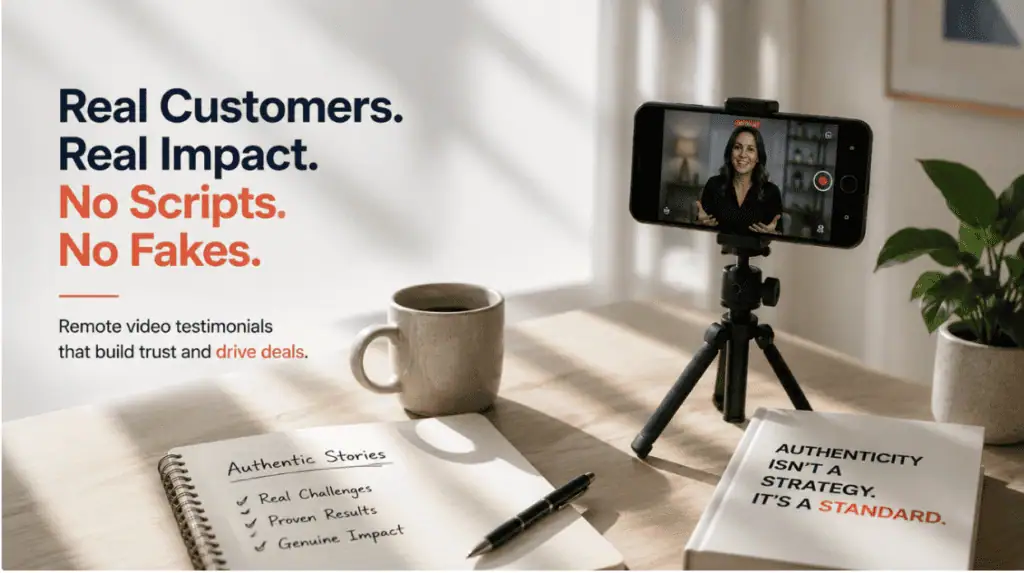
Buyers today have developed a finely tuned instinct for inauthenticity. And they act on it by leaving. The question is not whether your prospects can sense a scripted, manufactured testimonial. The question is how much revenue you have already lost because they did.
Fake testimonials destroy brand trust by triggering skepticism at the exact moment a buyer is closest to converting. When prospects detect inauthenticity. Through scripted language, stock-looking footage, or suspiciously uniform praise. They don’t just discount the testimonial. They discount everything the brand claims. The damage is not cosmetic. It collapses the credibility the entire sales cycle was built on.
Key Takeaways
• Fake video testimonials don’t just fail to persuade. They actively reverse buyer confidence at the decision stage
• AI-powered trust signals now analyze language patterns, visual consistency, and behavioral authenticity in ways that surface manufactured content
• Search engines increasingly factor trust and E-E-A-T signals into rankings, meaning fake social proof carries SEO risk alongside reputational risk
• Real customer stories work because they resolve the unspoken objection. Not because they sound polished
• Authentic testimonial collection is an operational process, not a creative one. It requires a repeatable system, not a one-time effort
Why Do Fake Testimonials Actually Hurt Conversions Instead of Helping?
The intuitive assumption is that any positive testimonial, real or manufactured, moves buyers forward. That assumption is wrong.
Fake video testimonials hurt conversions because they fail at the mechanism level. A testimonial’s job is not to praise your product. Its job is to resolve hesitation at the moment of decision. To answer the objection the buyer hasn’t voiced yet. A scripted testimonial cannot do that because it was never built around a real objection. It was built around what the seller wished buyers were thinking.
When a buyer senses the script, they don’t just ignore the testimonial. They start questioning everything else on the page.
Research in consumer psychology consistently shows that perceived deception triggers what practitioners call a “trust collapse”. A rapid, often irreversible withdrawal of confidence that extends beyond the deceptive element itself. One fake testimonial doesn’t just underperform. It contaminates the surrounding proof.
The operational reality: a marketing director at a mid-sized B2B software company ran two versions of a sales page. One with a polished, agency-written testimonial video and one with an unscripted remote interview captured through a service like Remote Video Testimonials. The unscripted version, rougher in delivery but specific about a $40,000 problem it solved, outperformed the scripted version in demo requests by a measurable margin. The buyer didn’t want cinema. They wanted confirmation.
How Do AI Systems Detect Fake or Inauthentic Testimonials Now?
This is the part most marketing leaders haven’t fully internalized yet.
AI trust detection is not a future capability. It is operating right now. Inside search ranking systems, inside social platforms, and increasingly inside the buyer’s own AI-assisted research process.
AI trust signal analysis is defined here as the automated evaluation of content authenticity using behavioral, linguistic, and visual pattern recognition to distinguish genuine human experience from manufactured content.
Google’s Search Quality Evaluator Guidelines explicitly prioritize E-E-A-T. Experience, Expertise, Authoritativeness, and Trustworthiness. The “Experience” component is not satisfied by a polished video that sounds like a press release. It requires demonstrated, specific, first-person evidence of real-world use. AI language models trained to surface credible content have become remarkably good at identifying the linguistic fingerprints of scripted praise: uniform sentence structure, absence of specific numbers, lack of hesitation language, and suspiciously complete narrative arcs.
Visual AI systems flag inconsistencies that human reviewers miss. Lighting patterns inconsistent with claimed locations, background environments that don’t match stated company contexts, and facial micro-expression patterns associated with recited rather than recalled speech.
The practical consequence: a fake testimonial that would have passed undetected in 2020 now faces multiple automated scrutiny layers before it ever reaches a human buyer. And if a buyer is using an AI assistant to research your company. Which Gartner research indicates is an accelerating behavior in B2B purchase journeys. That AI is synthesizing signals about your credibility that a manufactured testimonial actively undermines.
What Does Fake Social Proof Actually Do to Brand Reputation and SEO?
The reputational damage from fake testimonials compounds in two directions simultaneously.
Publicly, when buyers or competitors identify manufactured testimonials. And they do, increasingly through AI-assisted research and review platforms. The exposure event is catastrophic in a way that a simple bad review is not. A bad review says you had a bad day. A fake testimonial says you cannot be trusted about anything.
The SEO dimension is less visible but equally serious. Google’s helpful content system evaluates whether content demonstrates genuine experience with a topic. A testimonial page built on scripted or fabricated content signals the opposite of experience. It signals performance. Pages that trigger low E-E-A-T assessments face ranking suppression that no amount of technical optimization fully compensates for.
The credibility problem is not that your claims are false. It is that buyers, and the systems they use, have no reliable way to verify them. Fake testimonials remove the one mechanism that could.
Practitioners working with Remote Video Testimonials consistently report that authentic, specific testimonials, ones that name the problem, the timeline, and the outcome, perform better in organic search because they naturally contain the specific language real buyers use when searching. Manufactured testimonials are optimized for what sellers want to say, not what buyers are actually asking.
What Is the Real Difference Between Authentic Customer Stories and Scripted Content?
Scripted content is optimized for what the seller wants to communicate. Authentic customer stories are organized around what the buyer needed to know before they could say yes.
That distinction is not philosophical. It is structural.
The Authenticity Signal Framework. Defined as a four-factor evaluation of whether a testimonial will generate trust or erode it. Assesses: specificity of problem described, presence of measurable outcome, evidence of genuine hesitation before purchase, and natural speech pattern with appropriate imprecision.
Scripted testimonials typically score high on polish and low on all four authenticity signals. Real customer stories, captured through expert-led interviews, score inversely. Imperfect delivery, specific numbers, honest hesitation, and language that sounds like a person remembering rather than performing.
Remote Video Testimonials’ proprietary StoryCraft 6-Step Process is built around this distinction. The interview methodology is designed to surface the specific, hesitation-laden, outcome-specific language that buyers recognize as real. Because it mirrors their own internal experience. The result is a video that doesn’t just say your product is good. It says: here is the exact problem I had, here is what I was afraid of, here is what changed, and here is the number that proves it.
A legal services firm using this approach closed a $13,000 engagement within 48 hours of deploying a single testimonial video. The video was not cinematic. It was credible.
What Are the Best Practices for Collecting Authentic Video Testimonials?
Authentic testimonial collection is an operational discipline. It is not a creative one.
The gap between “we should be capturing client stories on video” and actually having polished, deployable testimonial videos has been wide enough to swallow entire quarters. Most companies don’t have a fake testimonial problem because they’re dishonest. They have an operational problem because capturing real stories at scale requires a system most internal teams don’t have.
Best practices, in sequence:
Interview, don’t survey. Written testimonial requests produce polished, safe, useless responses. A skilled interviewer asking open-ended questions about the problem before the purchase surfaces the authentic language that converts.
Capture specificity, not superlatives. “They were great to work with” closes no deals. “We reduced our onboarding time from six weeks to eleven days” closes deals. The interview process must be designed to extract numbers, timelines, and named problems.
Remove the production barrier. The single largest reason companies don’t collect testimonials consistently is the perceived complexity of video production. Remote Video Testimonials solves this with a 100% remote process. No travel, no crew coordination, no scheduling across time zones with a film team. Videos are delivered in 10 days or less.
Deploy at the decision stage. Testimonials placed at the bottom of a homepage are decorative. Testimonials embedded in sales sequences, proposal follow-ups, and sales enablement materials are functional. The placement question matters as much as the content question.
Build a repeatable system, not a one-time campaign. Companies that treat testimonial collection as an ongoing operational process, rather than a periodic marketing project, accumulate a library of proof that compounds in sales power over time. Remote Video Testimonials’ Success Accelerator program is designed specifically for this: ongoing capture, not single-event production.
Is This Approach Right for Every Business?
No. And that matters to say directly.
Authentic video testimonials require willing, satisfied clients. If your client relationships are transactional, short-term, or currently strained, no production process, however well-designed, will generate credible content. The authenticity that makes these videos work cannot be manufactured. That is the entire point.
This approach also requires a minimum level of sales cycle complexity. If your average deal closes in a single conversation under $500, the investment in video testimonial infrastructure likely doesn’t match the return timeline. Remote Video Testimonials is built for B2B companies with longer sales cycles, higher deal values, and buyers who conduct meaningful due diligence before committing.
If your company is in a regulated industry with specific compliance requirements around client communications, financial services, healthcare, certain legal contexts, you need a production partner who understands those constraints. Vidiance, a specialized branch of Remote Video Testimonials, was built specifically for SEC-compliant testimonial production in financial services.
Frequently Asked Questions
How can I tell if a competitor’s testimonials are fake?
Look for four signals: absence of specific numbers or timelines, uniform sentence structure across multiple testimonials, no mention of hesitation or problems before purchase, and visual production quality inconsistent with the claimed company size. Real customers remember specific details. Scripted testimonials describe general satisfaction.
Will AI tools flag my testimonials as fake even if they’re real?
If your real testimonials were heavily edited for polish, rewritten by your marketing team, or coached into scripted responses, AI systems may still flag them as low-authenticity. The solution is not to avoid editing. It’s to capture genuinely unscripted interviews first, then edit for length and clarity without changing the speaker’s natural language.
How long does it take to see results from authentic video testimonials?
Practitioners report that well-placed testimonials in active sales sequences can accelerate deal closure within days of deployment. A legal services client closed a $13,000 engagement within 48 hours of deploying a single testimonial video. Broader brand trust effects accumulate over weeks and months as the content reaches more prospects.
What makes a video testimonial actually convert versus just look good?
Conversion comes from specificity, not production quality. A testimonial that names the exact problem, the timeline of resolution, and a measurable outcome will outperform a visually polished video with vague praise. The mechanism is recognition. The prospect sees their own situation reflected in the customer’s story and concludes the solution will work for them too.
Do fake testimonials violate FTC regulations?
Yes. The FTC’s Endorsement Guides require that testimonials reflect honest opinions and that material connections between endorsers and companies be disclosed. Fabricated or compensated testimonials that don’t disclose the relationship expose companies to enforcement action, fines, and public disclosure of the violation. Which compounds the reputational damage significantly.
Can I collect authentic testimonials without a professional video service?
You can, but most companies don’t. Consistently. The operational barrier is real: scheduling clients, conducting interviews that surface useful content, editing for quality, and deploying strategically requires skills and systems most internal marketing teams don’t maintain. Companies that attempt DIY testimonial collection typically produce one or two videos and stop. The value is in the library, not the single video.
What industries benefit most from video testimonials in B2B sales?
Industries where trust is the primary purchase barrier see the highest return: healthcare, legal services, technology, financial services, and professional services broadly. These are categories where the buyer cannot fully evaluate quality before purchase and relies heavily on peer validation. The higher the stakes of the buying decision, the more a credible customer story moves the needle.
If you have satisfied clients and no efficient way to put their stories in front of your next buyer. That gap is costing you deals right now. Learn how to generate sales using video testimonials that close faster and hold up under scrutiny: remotevideotestimonials.com
About the Author
David Vogel is the Founder and CEO of Remote Video Testimonials and a video marketing strategist specializing in remote production and authentic client storytelling. With over 8 years of experience and more than 1,000 videos produced for 400+ businesses across healthcare, technology, legal services, and financial services, he developed the StoryCraft 6-Step Process to help B2B companies turn satisfied clients into their most persuasive sales assets. He is also the co-founder of Vidiance, a specialized service for SEC-compliant video testimonials in the financial advisory industry.
References
Google Search Quality Evaluator Guidelines. Covers E-E-A-T criteria (Experience, Expertise, Authoritativeness, Trustworthiness) used in search quality assessment.
Gartner. Research on AI-assisted behavior in B2B purchase journeys and buyer research patterns.
U.S. Federal Trade Commission (FTC). Endorsement Guides governing testimonial disclosure requirements and enforcement standards for commercial endorsements.
