

Most businesses understand that customer video testimonials build trust.
The problem is not convincing customers to participate.
The problem is building a process that consistently turns willing customers into polished, usable testimonial content.
That is where many businesses get stuck.
A customer may agree to record a testimonial, but once scheduling, coordination, production, editing, and follow-up enter the picture, the process often slows down or falls apart completely.
That operational gap is why many companies end up with only a few outdated testimonials instead of a repeatable system for customer proof.
Why Collecting Testimonials Becomes Difficult to Scale
At first, recording one testimonial may seem manageable.
But once businesses try to collect testimonials consistently across multiple customers, the complexity increases quickly.
Teams often run into challenges like:
- scheduling conflicts
- customer availability
- inconsistent recording quality
- unclear interview direction
- lengthy editing timelines
- internal coordination workload
The result is usually an inconsistent process that becomes difficult to maintain.
That inconsistency weakens one of the most important trust-building assets in the sales process.
Why Most Customer Testimonials Never Get Used
Many businesses technically collect testimonials.
But very few create testimonials that are actually useful in marketing and sales conversations.
Common problems include:
- unclear messaging
- low production quality
- poor audio or framing
- overly long interviews
- testimonials that lack structure
Even when the customer had a positive experience, the final video may not feel credible or persuasive enough to support buyer decisions.
That creates a trust gap between the testimonial and the potential customer watching it.
Why Guided Interviews Produce Better Customer Stories
The strongest testimonials are not created by asking customers to “say something nice on camera.”
They come from guided conversations that help customers explain:
- the original problem
- why they chose the business
- what the experience was like
- what changed afterward
A professionally guided interview helps customers:
- stay focused
- feel comfortable
- explain outcomes clearly
- communicate naturally
That structure produces stories that feel more believable and useful to future buyers.
Why Remote Production Makes Testimonial Collection Easier
Traditional testimonial production often becomes difficult because of logistics.
Businesses may need to:
- coordinate travel
- hire local crews
- align schedules across locations
- manage long production timelines
A remote testimonial process removes much of that friction.
Customers can participate from their own environment while still receiving professional guidance for:
- lighting
- framing
- audio
- interview flow
- pacing
This allows businesses to collect testimonials more consistently without disrupting the customer experience.
Why Consistency Matters More Than One Great Testimonial
Many companies focus on creating one impressive testimonial video.
The real value comes from building a repeatable system.
Consistent testimonial production helps businesses:
- reinforce credibility over time
- address different buyer objections
- support multiple industries or use cases
- strengthen long-term brand trust
- continuously create customer proof for sales conversations
That consistency has a much bigger business impact than producing occasional one-off videos.
Why Testimonials Help Buyers Make Decisions Faster
Buyers rarely make decisions based on marketing claims alone.
They want reassurance from someone who:
- had a similar challenge
- evaluated options carefully
- experienced measurable outcomes
Customer video testimonials help provide that reassurance.
When testimonials are professionally guided, clearly structured, and consistently produced, they become powerful trust-building assets throughout the buyer journey.
Frequently Asked Questions
Why do businesses struggle to collect testimonials consistently?
Most businesses lack a repeatable production process. Scheduling, coordination, interview quality, and editing often become difficult to manage consistently.
Why are guided interviews important?
Guided interviews help customers explain their experience naturally and clearly, creating stronger and more believable testimonials.
Does remote production reduce quality?
No. With professional guidance and structured workflows, remote testimonials can look polished and highly professional.
Why are testimonials important in B2B sales?
Testimonials help reduce buyer uncertainty by providing real customer proof instead of relying only on marketing claims.
Conclusion
The challenge with customer video testimonials is usually not customer willingness.
It is operational consistency.
Businesses that build a structured, professionally guided testimonial process are able to consistently create customer proof that supports trust, credibility, and sales conversations over time.
That is what turns testimonials from occasional marketing content into long-term business assets.
Build a Repeatable Customer Testimonial System
If your team struggles to consistently collect high-quality customer stories, the issue is usually the process behind them.
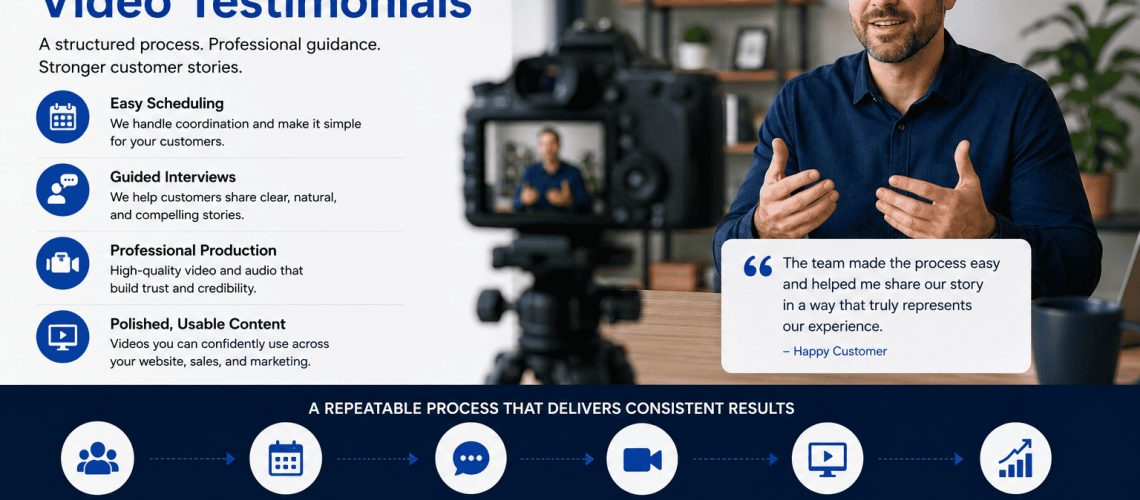
Remote Video Testimonials provides a managed remote testimonial system that helps businesses streamline scheduling, interviews, production, and editing without the complexity of traditional video production.
Book a strategy call to see how the process works.
