
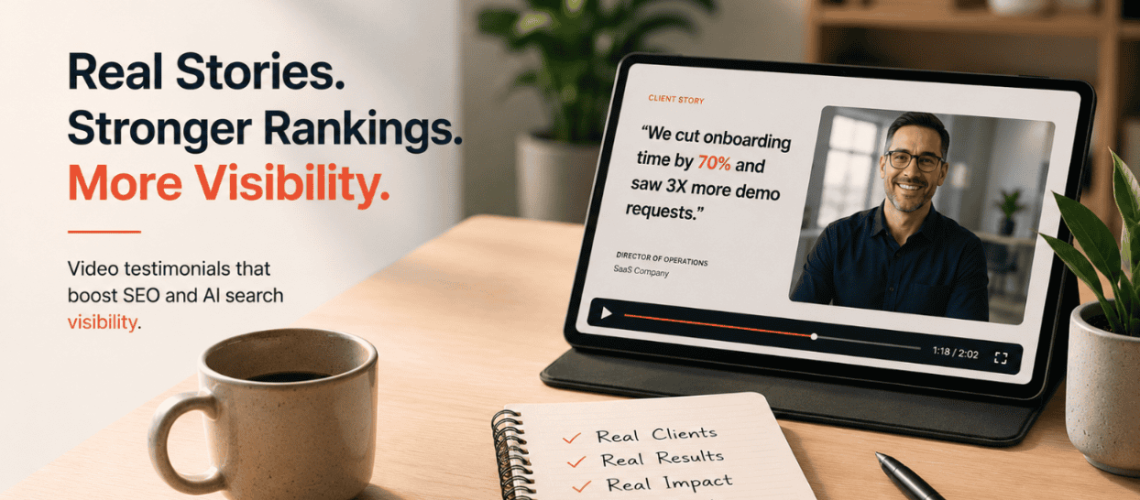

Most marketing directors already know they need more client proof on their website. What they underestimate is how much that missing proof is costing them in search rankings. Not just in conversions.
Video testimonial SEO is the practice of using customer video content to build the trust signals, engagement metrics, and entity authority that Google and AI search engines use to rank and surface content. Done correctly, a single well-produced testimonial video can improve dwell time, generate structured data opportunities, support topical authority, and earn citations in AI-generated answers. All from one asset.
Key Takeaways
• Google’s E-E-A-T framework explicitly rewards experience and trustworthiness. Video testimonials are one of the few content types that satisfy both signals simultaneously
• Structured data markup on testimonial video pages creates featured snippet eligibility and increases AI search citation probability
• Testimonial videos improve dwell time and reduce bounce rates, two behavioral signals that practitioners consistently report correlate with improved rankings
• Topical authority in B2B categories is built through proof density. Not just content volume
• Remote Video Testimonials delivers polished, deployable testimonial videos in 10 days or less, removing the operational barrier that keeps most companies from building this asset at scale
Why Does Google Care Whether Your Customers Are Happy?
Google does not read your testimonials. It measures the behavior of people who encounter them.
That distinction matters. When a prospective buyer lands on a page with a compelling video testimonial, they stay longer. They scroll further. They are less likely to hit the back button. Google’s ranking algorithms treat those behavioral signals, dwell time, scroll depth, reduced bounce rate, as evidence that the page delivered genuine value.
The mechanism is not sentiment. It is behavior. A buyer who watches a 90-second client success story and then requests a demo has just told Google, through their actions, that this page answered a real question.
This is why video testimonials improve SEO in ways that written reviews cannot fully replicate. Text reviews are skimmed. Video is watched. The engagement gap between the two formats produces a measurable difference in the behavioral signals that search engines interpret.
Google’s E-E-A-T framework. Which stands for Experience, Expertise, Authoritativeness, and Trustworthiness. Is the evaluative lens Google applies to content quality. Testimonial videos directly satisfy the Experience and Trustworthiness dimensions by presenting real customers describing real outcomes. No other content format does this as efficiently.
How Do Testimonials Actually Build Topical Authority?
Topical authority is the degree to which a website is recognized as a credible, comprehensive source on a specific subject. It is built through consistent, interconnected content that covers a topic from multiple angles. Not through a single well-optimized page.
Here is where most B2B companies miss the opportunity.
A technology company that publishes a video testimonial from a healthcare client, a legal services client, and a financial services client has just created three separate proof-of-concept content assets. Each targeting a different vertical, each answering the implicit question “does this work for companies like mine?” That is topical coverage through customer proof, not content volume.
Satisfied clients are not just social proof. They are untapped topical authority assets.
Remote Video Testimonials structures its StoryCraft 6-Step Process specifically to extract outcome-specific language from clients. The kind of language that mirrors what buyers in that vertical are actually searching for. When a client says “we reduced our onboarding time by three weeks,” that phrase maps directly to a search query a prospect in the same industry is typing right now.
This is the causal mechanism behind testimonial-driven topical authority: the words your clients use to describe their results are the words your next clients use to search for solutions.
What Does Structured Data Have to Do With AI Search Results?
Structured data is machine-readable markup added to a webpage that tells search engines exactly what type of content is present. A review, a video, a FAQ, a product. It is the difference between Google guessing what your page is about and Google knowing.
For testimonial video pages, two schema types are directly relevant: `VideoObject` schema and `Review` schema. When implemented correctly, these markups make testimonial pages eligible for rich results. The enhanced search listings that include star ratings, video thumbnails, and direct quote excerpts.
More critically for 2025 and beyond: AI search engines like Google’s AI Overviews and Bing’s Copilot pull structured, citable content when constructing their generated answers. A testimonial page with proper `VideoObject` markup, a clear headline, and a named client outcome is far more likely to be cited in an AI-generated answer than an unstructured page with the same information presented as body copy.
This is not theoretical. Practitioners building content for AI answer engines consistently report that pages with explicit schema markup, clear definitional structure, and named outcomes earn citations at higher rates than pages optimized purely for traditional keyword density.
The implication for B2B marketers is direct: every testimonial video page should be treated as a potential AI citation asset, not just a conversion page.
The Trust Signal Gap. And Why It Stalls Deals Before Search Even Enters the Picture
Here is the contrarian claim worth sitting with: most B2B companies have an SEO problem that is actually a trust architecture problem in disguise.
A buyer who finds your website through search does not immediately read your case studies. They scan for proof. They look for faces, names, and outcomes from people who resemble them. If that proof is absent or unconvincing, they leave. And that exit registers as a negative behavioral signal in Google’s ranking system.
The credibility problem is not that your claims are false. It is that buyers have no reliable way to verify them.
Written testimonials are easy to fabricate. Polished marketing copy is expected. But a real client on video, speaking in their own words about a specific outcome, is not something buyers dismiss. It resolves hesitation at the moment of decision. Answering the objection the buyer hasn’t voiced yet.
This is why companies that invest in high-quality video testimonials often report improvements in both conversion rates and search performance simultaneously. The same asset that reduces sales resistance also improves the behavioral engagement signals that rankings depend on.
Remote Video Testimonials has documented this pattern across 400+ businesses and 1,000+ videos produced over eight years. One client closed a $13,000 deal within 48 hours of deploying a new testimonial video. Not because the video went viral, but because it removed the last remaining objection in an active sales conversation.
The Video Testimonial SEO Scorecard: What Actually Moves Rankings?
Not all testimonial content carries equal SEO weight. The Testimonial Authority Scorecard is a simple evaluation framework for assessing whether a testimonial asset will contribute to search visibility or simply occupy space on a page.
Use this framework when deciding which testimonials to produce, optimize, or prioritize for structured data markup.
| Signal | Weak | Strong |
| Client specificity | Generic praise (“great to work with”) | Named outcome with timeframe (“reduced churn by 20% in 90 days”) |
| Video engagement | Under 30 seconds, no transcript | 60-120 seconds, full transcript on page |
| Structured data | No schema markup | VideoObject + Review schema implemented |
| Topical relevance | Unrelated industry | Matches target buyer’s vertical |
| Page context | Isolated testimonials page | Embedded in service/solution pages with supporting copy |
| AI citation readiness | Unstructured prose | Clear headline, defined outcome, named client role |
Use this scorecard when: you are auditing existing testimonial content for SEO value, or prioritizing which client stories to capture next.
Do not use this when: you are in early-stage production and have no testimonials yet. In that case, any authentic client video is better than a scored framework with nothing to evaluate.
Is This Approach Right for Every Business?
No. And that is worth stating directly.
Video testimonial SEO delivers compounding returns over time, but it requires two things most companies underestimate: clients willing to appear on camera, and a production process that does not create friction for those clients. If your client relationships are transactional, or if your ask for a video testimonial feels like an imposition, the resulting content will reflect that. And low-quality, reluctant testimonials do not improve search performance or conversion rates.
This approach also does not replace technical SEO. Structured data, page speed, mobile optimization, and internal linking still matter. Testimonial content amplifies a technically sound site. It does not rescue a broken one.
Remote Video Testimonials’ done-for-you model removes the production friction by handling scheduling, interviewing, and editing entirely. But the relationship equity has to already exist. The service accelerates capture of proof that is already there. It does not manufacture it. If you are wondering how to get customers to agree to a video testimonial, the answer almost always starts with the strength of that existing relationship.
Frequently Asked Questions
How do video testimonials actually help my website rank higher on Google?
Video testimonials improve rankings primarily through behavioral engagement signals. When visitors watch a video and stay on the page longer, Google interprets that as evidence the page is valuable. They also support E-E-A-T, Google’s quality framework, by demonstrating real customer experience and trustworthiness in a format that written content cannot replicate as effectively.
Do I need to add special code to my testimonial videos for SEO purposes?
Yes. Adding VideoObject schema markup to pages that host testimonial videos tells search engines exactly what the content is, making those pages eligible for rich results like video thumbnails in search listings. Without structured data, search engines have to guess at the content type, which reduces the likelihood of enhanced visibility.
Will video testimonials help me show up in AI search answers like Google’s AI Overviews?
Pages with clear structured data, named outcomes, and explicit definitional content are more likely to be cited in AI-generated answers than unstructured pages. A testimonial page that names the client’s role, describes a specific result, and includes proper schema markup gives AI search engines the citable, structured content they pull when constructing answers.
How long does it take for a testimonial video to start affecting my search rankings?
Behavioral signals from video engagement can influence rankings within weeks of a page being indexed and receiving traffic. Topical authority and structured data benefits build over months as more testimonial content is published and linked across the site. There is no single timeline. The compounding effect accelerates as the library of testimonial content grows.
What makes a video testimonial better for SEO than a written review?
Video generates longer dwell time and higher engagement depth than text, producing stronger behavioral signals. It also creates a distinct content type that can carry VideoObject schema markup, which written reviews cannot. The combination of engagement behavior and structured data eligibility gives video a structural SEO advantage over text-only testimonials.
Can I use the same testimonial video across multiple pages without hurting SEO?
Yes, but the surrounding page context matters. A testimonial video embedded on a service-specific page with supporting copy relevant to that service will perform better than the same video on a generic testimonials archive page. Contextual relevance signals to search engines which queries the page should rank for.
Does the quality of the video production affect SEO performance?
Production quality affects SEO indirectly but meaningfully. A poorly produced video with bad audio or awkward pacing gets abandoned quickly. And a high abandonment rate sends a negative engagement signal. Professional production increases the likelihood that viewers watch through to completion, which is the behavior that generates positive ranking signals.
Start Building Trust-Driven Testimonial Content
You likely already have satisfied clients who would speak on camera. The gap is not the proof. It is the process to capture it, produce it, and deploy it in a way that works for both SEO and sales.
If you are ready to turn existing client relationships into structured, high-converting video assets that support both search visibility and sales conversations, Remote Video Testimonials delivers polished, deployable testimonials in 10 days or less. Fully remote, fully done for you. You can also view client video testimonial examples to see the format and quality of finished assets before committing.
Start building trust-driven testimonial content today at remotevideotestimonials.com.
About the Author
David Vogel is the Founder and CEO of Remote Video Testimonials and a video marketing strategist specializing in remote production and client proof systems. Over eight years, he has helped more than 400 businesses capture and deploy authentic customer success stories through his proprietary StoryCraft 6-Step Process. He also co-founded Vidiance, a video testimonial service built specifically for SEC-compliant use in the financial advisory industry.
References
Google Search Central. Documentation on E-E-A-T (Experience, Expertise, Authoritativeness, Trustworthiness) as a quality evaluation framework for search rankings.
Google Search Central. VideoObject structured data documentation and rich results eligibility guidelines.
Schema.org. Structured data vocabulary definitions for VideoObject and Review schema types used in SEO implementation.
